

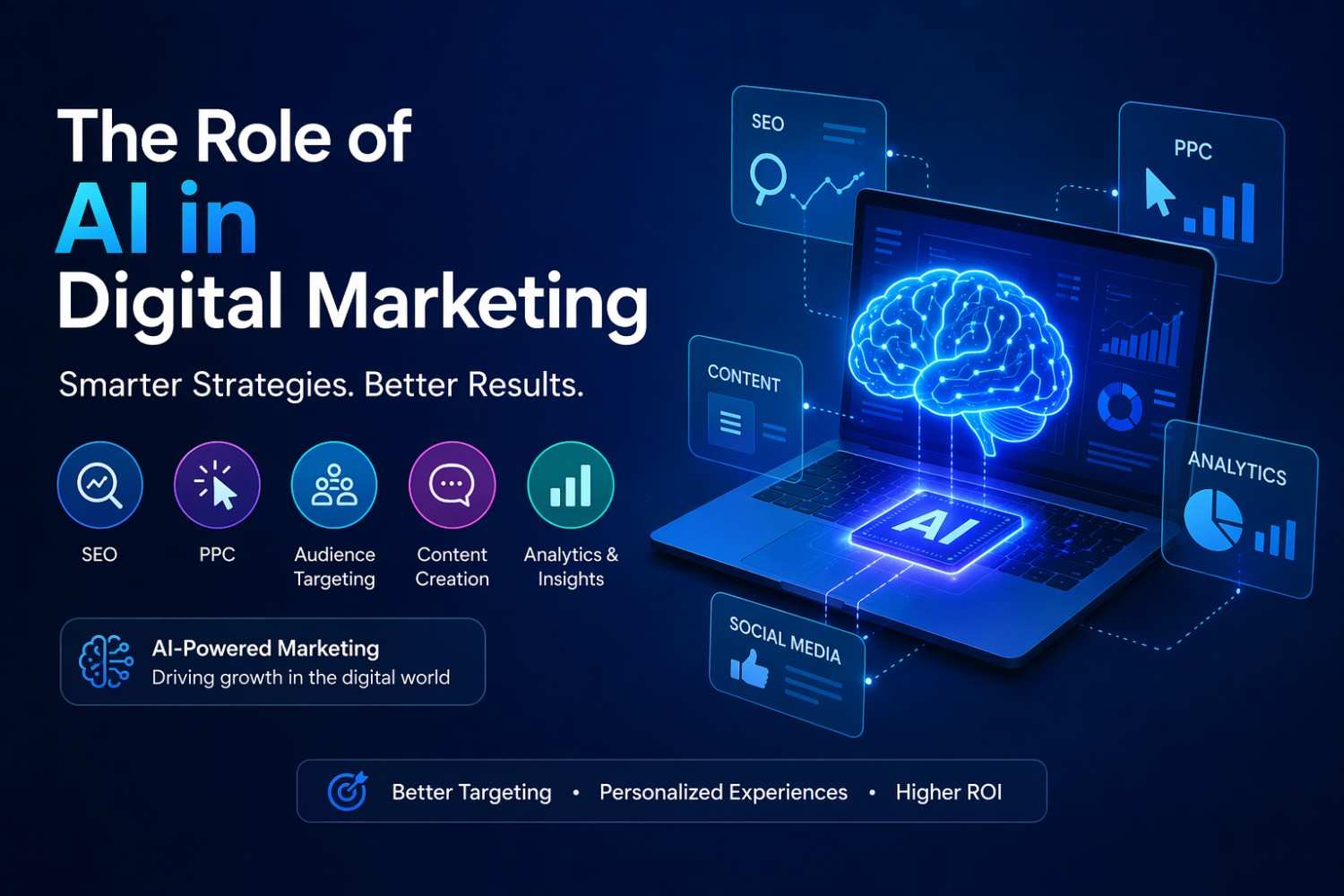
Digital marketing is no longer just about keywords, ads, and content. It is now about data, automation, and intelligence. This is where AI in digital marketing is changing everything.
From search engine optimization (SEO) to PPC (pay-per-click advertising), from content creation to customer targeting, artificial intelligence in marketing is helping businesses grow faster, smarter, and more efficiently.
In this blog, you’ll clearly understand the role of AI in digital marketing, how it works in SEO strategy (organic) and PPC strategy (paid), and why it is shaping the future of marketing.
ALSO READ: Difference Between SEO and SMO: Which Is Better for Business Growth in 2026?
What is AI in Digital Marketing?
AI in digital marketing means using machine learning, data analysis, and automation tools to improve marketing performance.
Instead of guessing what works, AI helps you:
Analyze customer behavior
Predict trends
Automate campaigns
Personalize content
This leads to better decisions and higher ROI in both search engine optimization strategies and PPC marketing campaigns.
Role of AI in Digital Marketing
The role of AI in digital marketing is growing every day. It is not just a trend—it is becoming the foundation of modern marketing, especially in search engine optimization (SEO) and PPC campaign management.
1. Data-Driven Marketing Decisions
AI can analyze large amounts of data in seconds. It helps marketers understand:
What users are searching
What content works
Which campaigns convert
This makes marketing more accurate and result-driven, especially for SEO performance tracking and PPC analytics.
2. Customer Behavior Analysis
AI tracks user behavior like:
Clicks
Time spent on pages
Purchase patterns
This helps in creating personalized marketing strategies that improve both organic search engine optimization results and paid PPC conversions.
3. Marketing Automation
With AI marketing automation tools, you can:
Schedule campaigns
Send automated emails
Run chatbots
This saves time and improves efficiency across SEO workflows and PPC campaign execution.
4. Content Creation & Optimization
AI tools can now:
Generate blog ideas
Suggest keywords
Optimize content for SEO
This improves content quality and ranking chances in search engine optimization, while also supporting landing page optimization for PPC ads.
5. Predictive Analytics
AI predicts:
Future trends
Customer actions
Campaign performance
This allows businesses to stay ahead in both organic SEO strategies and paid PPC strategies.
ALSO READ: Why SEO optimization is important for online growth?
AI in SEO Strategy (Organic Growth)
AI is completely transforming SEO strategy (organic). Modern search engine optimization is no longer manual—it is AI-assisted.
1. Keyword Research with AI
AI tools help find:
High-ranking keywords
Long-tail keywords
Search intent keywords
This improves organic traffic and search engine optimization performance.
👉 Popular AI SEO tools:
Surfer SEO
Ahrefs
SEMrush
Ubersuggest
2. Content Optimization
AI analyzes:
Readability
Keyword usage
Content structure
It ensures your content is SEO-friendly and aligned with search engine optimization best practices.
3. Search Intent Understanding
AI helps understand:
Informational intent
Transactional intent
Navigational intent
This is critical for modern search engine optimization rankings.
4. Voice Search & AI
With voice assistants growing, AI helps optimize for:
Conversational queries
Natural language keywords
This is the next phase of search engine optimization evolution.
5. AI & Google Algorithms
Google uses AI systems like:
RankBrain
BERT
These focus on:
Context
Relevance
User experience
So, even though keyword placement matters in search engine optimization, real success comes from valuable and user-focused content.
AI in PPC Strategy (Paid Marketing)
AI is also transforming PPC strategy (paid). Today’s PPC advertising is heavily dependent on AI algorithms.
1. Smart Bidding
AI automatically adjusts bids based on:
User behavior
Device
Location
This improves PPC campaign performance and ROI.
2. Audience Targeting
AI helps target:
Right audience
Right time
Right platform
This makes PPC advertising more cost-effective.
3. Ad Copy Optimization
AI tests multiple ad variations and selects the best-performing ones, improving PPC ad performance.
4. Predictive Performance
AI predicts:
Which ads will perform better
Which audience will convert
This strengthens your overall PPC strategy.
5. Budget Optimization
AI distributes budget across campaigns for maximum results in paid PPC campaigns.
👉 Popular AI PPC tools:
Google Ads
Meta Ads Manager
WordStream
Optmyzr
How AI is Changing the Future of Marketing
The future of marketing is AI-driven, especially in search engine optimization and PPC advertising.
1. Hyper-Personalization
AI delivers:
Personalized emails
Customized ads
Tailored content
This improves both SEO engagement signals and PPC conversion rates.
2. AI Chatbots & Customer Support
AI-powered chatbots provide:
24/7 support
Instant replies
Better customer experience
This supports lead generation from both SEO and PPC traffic.
3. Predictive Marketing
AI predicts customer needs before they act. This leads to:
Higher conversions
Better targeting
Works effectively across organic SEO and paid PPC funnels.
4. Automation at Scale
Marketing tasks that took hours now take minutes:
Campaign setup
Reporting
Optimization
This is especially powerful in managing large-scale SEO and PPC campaigns.
5. AI + Human Collaboration
AI will not replace marketers. Instead:
AI handles data & automation
Humans focus on creativity & strategy
This balance is key for success in search engine optimization and PPC marketing.
Benefits of AI in Digital Marketing
Faster decision-making
Better targeting
Improved ROI
Time-saving automation
Higher engagement
Challenges of AI in Marketing
High initial cost
Learning curve
Dependence on data
Privacy concerns
Future Trends of AI in Digital Marketing
AI-generated content will increase
Voice search optimization will grow
AI-powered search engine optimization tools will dominate
Automation in PPC advertising will become standard
Data privacy will become more important
ALSO READ: Why Digital Marketing Is Important for Small Businesses in 2026?
Conclusion
The role of AI in digital marketing is no longer optional—it is essential.
From improving search engine optimization (SEO strategy) to optimizing PPC strategy (paid advertising), AI is making marketing smarter and more efficient.
If you want to stay ahead, focus on:
AI-powered SEO strategies
Data-driven PPC campaigns
User intent and personalization
High-quality content
Because the future of marketing is not just digital—it is AI-powered and performance-driven.