

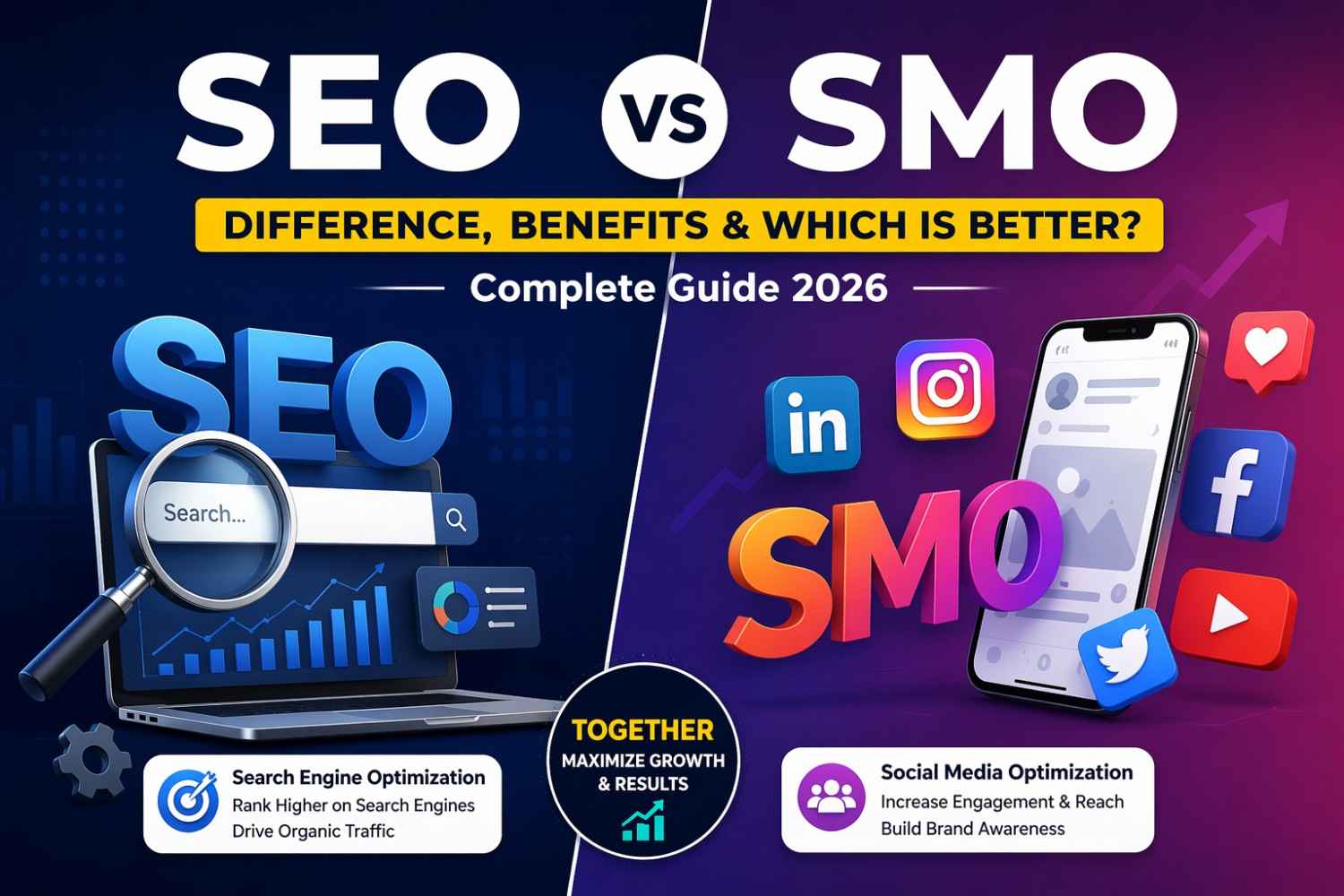
If you are building your online presence in 2026, you have probably heard two common terms in digital marketing: SEO and SMO. Many beginners, business owners, and even marketers often ask about the difference between SEO and SMO because both help brands grow online, but they work in very different ways.
The truth is simple: SEO helps your website rank on search engines like Google, while SMO helps your brand grow across social media platforms like LinkedIn, Instagram, Facebook, and X. When used together, they create a powerful growth engine that improves visibility, traffic, engagement, and lead generation.
In this complete guide, we will break down the SEO vs SMO difference, explain how each works, compare benefits, and help you decide which one is better for your business goals.
What Is SEO?
SEO (Search Engine Optimization) is the process of optimizing your website so it ranks higher on search engines for targeted keywords.
For example, if your business wants to rank for “website development cost in India”, SEO helps your page appear on Google when users search for that term.
SEO mainly focuses on:
1) On-Page SEO
This includes:
Keyword optimization
Meta titles and descriptions
Internal linking
Header tags (H1, H2, H3)
Image alt text
Content quality
2) Off-Page SEO
This includes:
Backlinks
Brand mentions
Guest posting
PR and citations
3) Technical SEO
This includes:
Website speed
Mobile responsiveness
Schema markup
Crawlability
Core Web Vitals
The main objective of SEO is long-term organic traffic and qualified leads.
ALSO READ: Why SEO optimization is important for online growth?
What Is SMO?
SMO (Social Media Optimization) means optimizing your social media presence to improve visibility, engagement, profile visits, followers, and website traffic.
While SEO works on Google, SMO works on platforms like LinkedIn, Instagram, Facebook, Pinterest, YouTube, and X.
SMO includes:
Optimized social media bios
Keyword-rich captions
Hashtag clusters
Consistent branding
Profile link optimization
Content posting schedule
Reels, carousels, and video optimization
Engagement strategies
For example, if you post regularly on LinkedIn about digital marketing trends, optimize hashtags, and use strong CTAs, that is SMO.
The main goal of SMO is reach, engagement, brand awareness, and social traffic.
Difference Between SEO and SMO
Here is the most important section to clearly understand the difference between SEO and SMO.
Factor | SEO | SMO |
|---|---|---|
Full Form | Search Engine Optimization | Social Media Optimization |
Main Platform | Google, Bing | LinkedIn, Instagram, Facebook |
Goal | Website rankings and organic traffic | Reach, engagement, followers |
Content Type | Blogs, landing pages, service pages | Posts, reels, stories, carousels |
Time to Results | Medium to long term | Faster visibility |
KPI | Rankings, CTR, traffic, leads | Likes, comments, shares, profile visits |
Traffic Source | Search engines | Social media platforms |
User Intent | Search-based demand | Discovery and engagement |
This table is the easiest way to explain SEO vs SMO to beginners and clients.
SEO vs SMO: Which One Is Better?
The answer depends on your business objective.
Choose SEO If You Want:
Long-term organic traffic
High-intent leads
Better Google rankings
Evergreen content visibility
Better ROI over time
SEO is perfect for service businesses, SaaS companies, agencies, bloggers, and eCommerce stores.
Choose SMO If You Want:
Faster visibility
Brand awareness
Audience engagement
Community building
Personal branding
Thought leadership
SMO is highly effective for creators, coaches, local brands, consultants, and B2C businesses.
The Best Strategy: Use Both Together
The smartest businesses do not choose one. They combine SEO + SMO.
SEO brings traffic from search engines, while SMO amplifies the content to the right audience.
ALSO READ: Why Digital Marketing Is Important for Small Businesses in 2026?
How SEO and SMO Work Together
This is where most brands unlock serious growth.
1) Social Media Boosts Blog Reach
When you publish a blog, share it on LinkedIn, Facebook, Pinterest, and X.
This drives:
Early traffic
Engagement signals
More shares
Higher chances of backlinks
2) SEO Content Fuels Social Posts
One blog can become:
5 LinkedIn posts
3 carousel ideas
1 Instagram reel
1 Pinterest infographic
1 email newsletter
This creates a complete content distribution system.
3) Brand Searches Improve
When people repeatedly see your content on LinkedIn or Instagram, they start searching your brand name on Google.
This improves:
Branded search volume
CTR
Authority signals
Trust
4) Better Conversion Journey
A user may:
Find your blog via Google
Follow you on LinkedIn
Engage with your content
Visit your website later
Convert into a lead
That is why SEO and SMO together create better conversions.
Common Mistakes Businesses Make
Many brands fail because they misunderstand the difference between SEO and SMO.
Avoid these mistakes:
SEO Mistakes
Keyword stuffing
Thin blog content
Poor internal linking
Ignoring technical SEO
Duplicate pages
No schema markup
SMO Mistakes
Posting without strategy
Wrong hashtag usage
No CTA in captions
Inconsistent branding
Ignoring comments
Reposting the exact same content on all platforms
The right strategy is platform-specific optimization.
Best Use Case for SEO and SMO in 2026
Here is a practical example.
Imagine you write a blog on:
SEO Role
The blog ranks on Google for targeted keywords.
SMO Role
You create:
LinkedIn comparison post
Instagram carousel
Pinterest infographic
X thread
YouTube Shorts explainer
This multiplies the reach and improves lead generation from multiple channels.
Final Verdict: SEO vs SMO
So, what is the final answer to the difference between SEO and SMO?
SEO helps people find you when they search.
SMO helps people discover you when they scroll.
SEO builds long-term visibility.
SMO builds brand awareness and trust faster.
For maximum business growth in 2026, the ideal strategy is:
Rank with SEO. Amplify with SMO. Convert with both.
That is the real winning digital marketing formula.