AEO, GEO, AIO, and AXO Explained: What's the Difference?
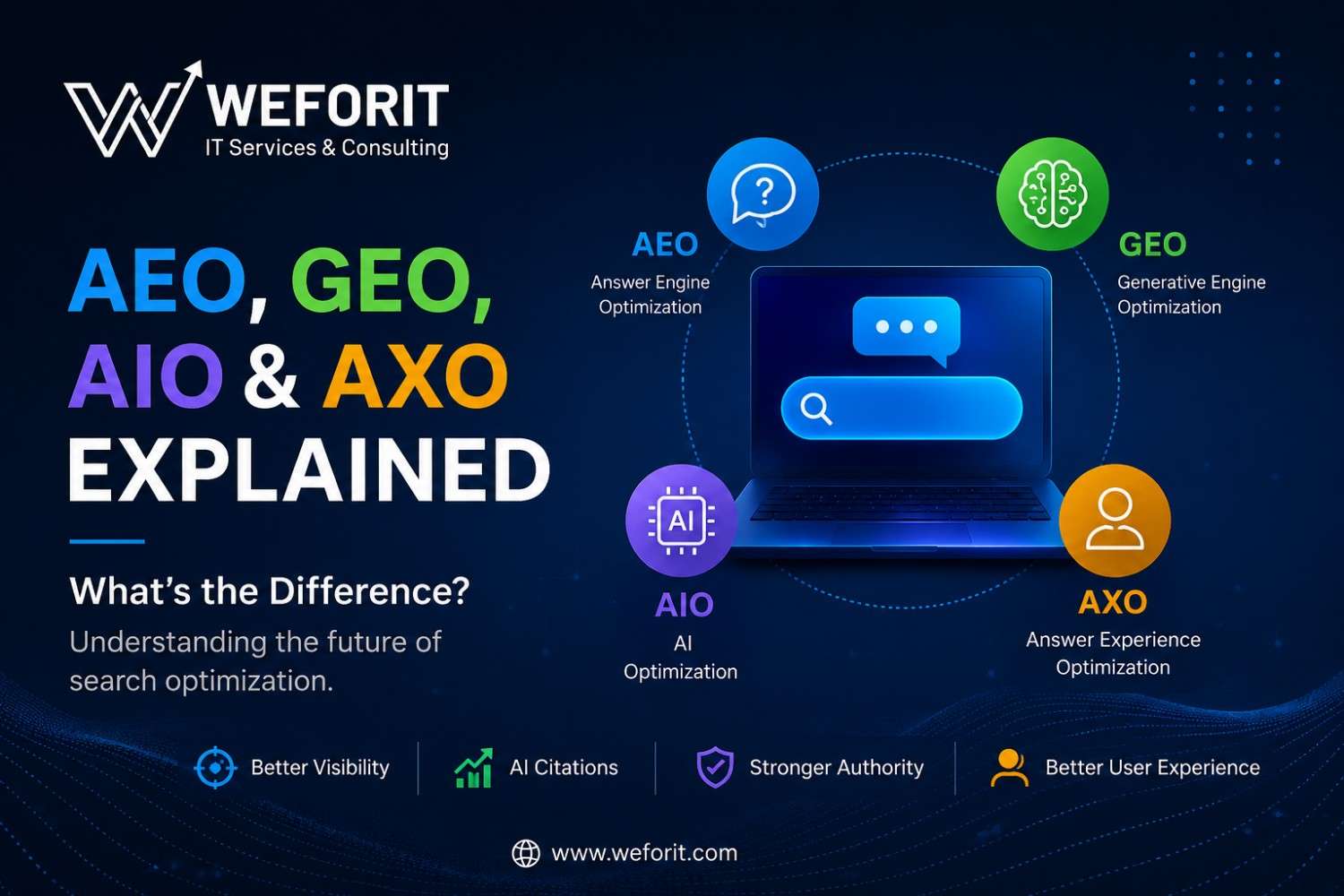
The way people search for information is changing rapidly. For years, businesses focused on Search Engine Optimization (SEO) to improve rankings on Google and other search engines. While SEO remains important, the rise of AI-powered platforms such as ChatGPT, Gemini, Claude, Perplexity, and Google AI Overviews has introduced new ways for users to discover information.
Today, users are increasingly asking questions instead of typing keywords. They expect direct answers, personalized recommendations, and conversational responses. As a result, new optimization strategies have emerged, including Answer Engine Optimization (AEO), Generative Engine Optimization (GEO), AI Optimization (AIO), and Answer Experience Optimization (AXO).
Many marketers use these terms interchangeably, but they are not the same. Understanding the differences can help businesses improve visibility across both traditional search engines and AI-powered platforms.
In this guide, we'll break down AEO, GEO, AIO, and AXO, explain how they work, and show how they fit into the future of search.
Why Search Optimization Is Evolving
Think about how people search today.
Instead of searching:
- Best CRM software
Users now ask:
- What is the best CRM software for a small business?
- Which CRM is easiest to use for startups?
- What CRM tools do marketers recommend in 2026?
These longer, conversational searches are becoming common across AI-powered platforms.
This shift means businesses need to optimize not only for search engines but also for AI systems that generate answers and recommendations.
What Is AEO (Answer Engine Optimization)?
Answer Engine Optimization (AEO) is the process of optimizing content so that search engines and answer engines can easily provide direct answers to user questions.
According to Google Search Essentials, content that is helpful, reliable, and written for people is more likely to perform well in modern search experiences.
The goal of AEO is simple:
Help your content become the answer.
AEO focuses on:
- Featured snippets
- People Also Ask sections
- Voice search results
- AI-generated summaries
- Quick answer boxes
How AEO Works
AEO helps search engines understand:
- What question is being answered
- How clearly the answer is written
- Whether the answer is trustworthy
For example:
Prompt:
"What is Answer Engine Optimization?"
AEO-friendly answer:
"Answer Engine Optimization (AEO) is the practice of creating content that helps search engines and AI systems deliver direct answers to user questions."
AEO Best Practices
- Answer questions directly.
- Use FAQ sections.
- Add structured data where appropriate.
- Create concise definitions.
- Use clear heading structures.
- Focus on user intent.
Benefits of AEO
- Higher visibility in search results
- Increased chances of appearing in featured snippets
- Better voice search performance
- Improved AI Overview visibility
What Is GEO (Generative Engine Optimization)?
Generative Engine Optimization (GEO) focuses on improving a brand's visibility within AI-generated responses.
Instead of ranking a webpage, GEO aims to increase the likelihood that AI systems mention or cite your brand when generating answers.
This includes platforms such as:
- ChatGPT
- Gemini
- Claude
- Perplexity
- AI search engines
How GEO Works
When AI systems generate answers, they use information from multiple sources.
GEO helps ensure your content is:
- Trustworthy
- Well-structured
- Frequently referenced
- Easy for AI systems to understand
For example:
Prompt:
"Which digital marketing agencies are known for SEO and AI visibility services?"
A GEO-optimized brand has a greater chance of appearing in the generated response.
GEO Best Practices
- Publish expert-level content.
- Build strong brand authority.
- Earn mentions from reputable websites.
- Create original research and insights.
- Maintain content accuracy.
- Strengthen digital PR efforts.
Benefits of GEO
- More AI-generated brand mentions
- Higher AI citations
- Increased brand awareness
- Better visibility across AI platforms
As AI search continues to evolve, platforms supported by Google AI Overviews and other generative systems increasingly rely on trusted and authoritative sources when generating answers.
What Is AIO (AI Optimization)?
AI Optimization (AIO) is a broader strategy focused on making a website, content, and brand more discoverable and understandable for artificial intelligence systems.
Think of AIO as the umbrella category.
It combines elements of:
- SEO
- AEO
- GEO
- Structured content
- AI-friendly information architecture
The goal is to help AI systems understand:
- Who you are
- What you offer
- Why your brand is relevant
How AIO Works
AIO ensures that AI systems can easily identify:
- Brand information
- Services
- Expertise
- Products
- Industry relevance
For example:
Prompt:
"Which companies provide digital marketing services in India?"
AI systems should be able to understand:
- Your company
- Your services
- Your expertise
- Your market presence
AIO Best Practices
- Create entity-focused content.
- Maintain consistent brand information.
- Use structured content formats.
- Build topical authority.
- Improve website trust signals.
- Publish expert content regularly.
Benefits of AIO
- Improved AI discoverability
- Better AI understanding of your brand
- Enhanced visibility across AI ecosystems
- Stronger long-term digital presence
Using Schema.org Structured Data helps search engines and AI systems better understand entities, services, products, and relationships across your website.
What Is AXO (Answer Experience Optimization)?
Answer Experience Optimization (AXO) focuses on the quality of the user's experience after receiving an answer.
Getting mentioned by AI is important.
Providing a useful experience after that mention is equally important.
AXO considers:
- Content clarity
- User engagement
- Information quality
- Ease of understanding
- Trustworthiness
How AXO Works
Imagine a user asks:
Prompt:
"How can a small business improve local SEO?"
The AI provides an answer and links to your content.
If your content is:
- Easy to read
- Well-structured
- Helpful
- Actionable
The user is more likely to trust your brand.
AXO Best Practices
- Use simple language.
- Improve content readability.
- Add visual elements.
- Provide actionable steps.
- Improve page experience.
- Keep content updated.
Benefits of AXO
- Better user engagement
- Higher trust
- Improved conversions
- Stronger customer experience
AEO vs GEO vs AIO vs AXO: Key Differences
| Factor | AEO | GEO | AIO | AXO |
|---|---|---|---|---|
| Full Form | Answer Engine Optimization | Generative Engine Optimization | AI Optimization | Answer Experience Optimization |
| Primary Goal | Provide direct answers | Increase AI mentions and citations | Improve AI discoverability | Improve user experience |
| Main Focus | Questions and answers | AI-generated responses | AI understanding | User satisfaction |
| Target Platforms | Search engines and answer engines | ChatGPT, Gemini, Claude, Perplexity | AI ecosystems | All digital touchpoints |
| Success Metric | Featured snippets and direct answers | Brand mentions and citations | AI visibility | Engagement and conversions |
| Content Style | Concise and direct | Authoritative and trustworthy | Structured and comprehensive | User-friendly and actionable |
How These Strategies Work Together
Many businesses ask:
Prompt:
"Should I focus on AEO, GEO, AIO, or AXO?"
The answer is not one or the other.
The strongest digital strategy combines all four.
Example
AEO helps answer questions.
GEO helps AI systems mention your brand.
AIO helps AI understand your business.
AXO helps users have a positive experience.
Together, they create a complete optimization framework.
A Modern Optimization Stack
- Start with strong SEO foundations.
- Build AEO-friendly content.
- Improve AI visibility through GEO.
- Strengthen AI discoverability with AIO.
- Enhance user experience with AXO.
Common AI Search Prompts Businesses Should Optimize For
Modern content should answer real-world prompts such as:
- What is the best SEO agency for small businesses?
- Which digital marketing services provide the highest ROI?
- How does AEO differ from traditional SEO?
- What is Generative Engine Optimization?
- How can businesses improve AI visibility?
- Which companies are recommended for AI search optimization?
- What is the future of search marketing?
Creating content around these prompt-based questions increases visibility across AI-powered search platforms.
The Future of Search Optimization
Search is becoming increasingly conversational.
Users are no longer looking only for links.
They want:
- Answers
- Recommendations
- Comparisons
- Expert insights
- Personalized responses
As AI-powered search continues to grow, businesses that focus only on traditional SEO may miss valuable opportunities.
Future-ready brands will invest in:
- SEO for search engines
- AEO for direct answers
- GEO for AI mentions and citations
- AIO for AI discoverability
- AXO for better user experiences
Together, these strategies create a stronger digital presence across both search engines and AI platforms.
Conclusion
The future of search is no longer limited to ranking on Google. Users are increasingly turning to AI platforms like ChatGPT, Gemini, Claude, and Perplexity to find answers, compare options, and make decisions.
This shift has introduced new optimization approaches such as AEO, GEO, AIO, and AXO.
While each strategy serves a different purpose, they work best when combined. AEO helps your content become the answer, GEO improves AI mentions and citations, AIO makes your brand easier for AI systems to understand, and AXO ensures users have a positive experience after discovering your content.
Businesses looking to improve visibility across AI-powered search experiences should monitor developments across ChatGPT, Google AI Overviews, and other emerging answer engines.
Businesses that embrace these approaches today will be better positioned to improve AI visibility, strengthen brand authority, and remain discoverable in the evolving search landscape. The future belongs to brands that optimize not only for search engines but also for the AI systems shaping how information is found and consumed.
Frequently Asked Questions
What is the difference between AEO, GEO, AIO, and AXO?
Answer Engine Optimization (AEO) focuses on helping content become the direct answer to user questions in search engines, voice assistants, and AI-generated summaries.
Generative Engine Optimization (GEO) focuses on increasing the chances of a brand being mentioned or cited in AI-generated responses from platforms like ChatGPT, Gemini, Claude, and Perplexity.
AI Optimization (AIO) is a broader approach that helps AI systems understand a brand, its services, expertise, and content. It includes elements of SEO, AEO, GEO, and structured data optimization.
Answer Experience Optimization (AXO) focuses on improving the user experience after an answer is delivered. It ensures content is clear, helpful, trustworthy, and easy to consume.
When comparing AEO, GEO, AIO, and AXO, it is important to understand that they are complementary strategies. Together, they help businesses improve visibility across traditional search engines and AI-powered search platforms.
Why are AEO, GEO, AIO, and AXO important for businesses in 2026?
AEO helps businesses appear as direct answers to questions.
GEO helps businesses earn AI-generated mentions and citations.
AIO helps AI systems understand a company's expertise, products, and services.
AXO ensures visitors have a positive experience after discovering the content.
Businesses that invest in AEO, GEO, AIO, and AXO are better positioned to improve AI visibility, increase brand authority, attract qualified traffic, and stay competitive as search becomes increasingly AI-driven.
Can AEO, GEO, AIO, and AXO replace traditional SEO?
SEO remains essential because search engines and AI systems still rely on websites to discover, understand, and evaluate information. Technical SEO, content optimization, internal linking, topical authority, and backlinks continue to play an important role.
However, modern businesses need more than SEO alone. AEO helps content become the answer, GEO improves AI citations and mentions, AIO increases AI discoverability, and AXO enhances the overall answer experience.
The most effective digital marketing strategy combines SEO with AEO, GEO, AIO, and AXO to maximize visibility across both traditional search engines and AI-powered platforms.
How can businesses implement AEO, GEO, AIO, and AXO effectively?
Some best practices include:
Creating detailed guides and educational content
Adding FAQ sections to important pages
Using structured data and schema markup
Building topical authority around key subjects
Earning mentions from reputable websites
Publishing original research and industry insights
Maintaining consistent brand information online
Improving page experience and content readability
To succeed with AEO, GEO, AIO, and AXO, businesses should focus on becoming trusted sources of information. AI systems are more likely to reference brands that consistently publish accurate, useful, and authoritative content. Over time, this can lead to greater visibility in search results, AI-generated answers, and customer decision-making journeys.
Written by: